Crafting a campaign that builds donor confidence
Donors believe in the vision faster when you demonstrate why they should trust you.
Every capital campaign asks donors to believe in something that doesn't exist yet. Before the building is complete, before the impact can be measured, people have to trust that the organization can deliver on its promise. There is a lot of academic research about donor trust in organizational efficiency: financial stewardship, governance, and measurable outcomes. But communication matters too. Long before someone reviews an annual report or charity rating, they're forming impressions based on the organization's own materials. How can nonprofits build trust through their direct communications, and how can these trust signals support key moments of growth?
Through my practice of studying and working in nonprofit communications, I have the opportunity to review many campaigns. Campaigns that feel underdeveloped can raise doubt, while campaigns that are aligned and confident build momentum. The difference often lies in the materials themselves: not just what they say, but how they work together to demonstrate quality and discipline. Are the materials communicating thoughtfully and clearly? Are they easy to read and understand? Do they communicate the level of care the organization is asking donors to invest in?


Equipping every voice for success
Kinship Community Food Center’s challenge was the same one that many nonprofits face in a capital campaign: to communicate a large, transformative ask in a way that built trust, understanding, and confidence among donors.
When they embarked on a significant fundraising effort for their new home, the campaign called on staff, board members, and volunteers to represent the effort in whatever way they could best reach potential donors: meetings, presentations, and one-on-one conversations. To succeed, everyone needed tools that built and reinforced trust, telling the same story in the same way, across any form of media that was called for; digital presentations, printed materials, and written communications.
Ravenwood Design Group joined a collaborative team that included Kinship’s fundraising consultant, development director, communications associate, and executive leadership. I led the visual design, shaping a system that made the campaign’s organization and preparedness visible. The end result was campaign materials that made the message easy to deliver, in a way that is representative of the level of care Kinship brings to everything they do.
A short-term sub-brand with long-term alignment
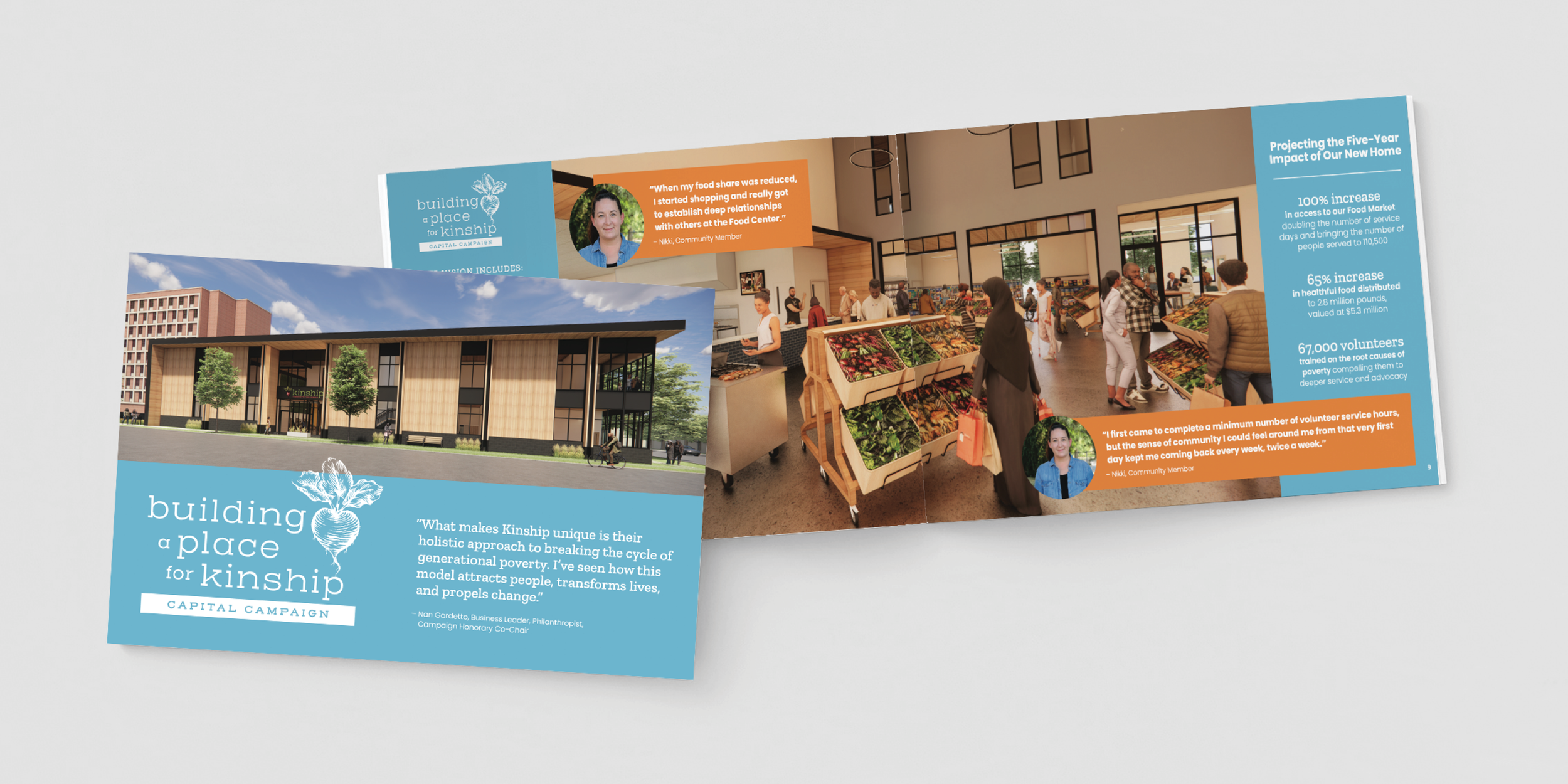
The campaign drew from Kinship’s most recognizable brand assets—its typography, tone, and core visual cues—to create a dedicated campaign logo and palette. The result felt like Kinship, but carried the focus and polish of a major fundraising effort.
By investing care and attention in the campaign materials, Kinship demonstrated the same readiness it was asking donors to support. Consistent design gave the campaign continuity across presentations, print materials, and communications. Each piece was organized, clear, and consistent, reflecting the discipline behind the campaign itself.
RDG also encouraged a narrative structure that followed one person’s experience through Kinship’s ecosystem. That single story helped donors understand the depth of the organization without flattening it, translating a nuanced model into a more approachable narrative.


Making an ambitious goal feel achievable
Every element–visual, structural, and narrative–worked together to make Kinship’s vision feel tangible and within reach. The materials gave everyone involved the tools to communicate from a shared narrative foundation, allowing preparation itself to act as proof of readiness. A strong campaign can achieve its goal. It can also leave behind something more lasting: a shared understanding of the organization's vision that continues to shape how people communicate long after the campaign ends.


Special thanks to HGA, McDonald Schaefer, and the Kinship team.
Creative Direction & Strategy
McDonald Schaefer
Lydia Ravenwood
Art Direction
Lydia Ravenwood
Graphic Design
Lydia Ravenwood
Quyen Tonnu
Meghan Polzin
Sarah Schauf